Key takeaways
- VR wins at rare emergencies, spatial skills, consistent assessment and detailed records.
- Classroom training still wins at law, theory, discussion and small one-off courses.
- Real equipment remains essential for the final feel and for licence assessments.
- PwC's 2020 study found VR learners trained up to four times faster than classroom learners, with cost parity at about 375 learners.
The short answer
VR training is not better than classroom training at everything. It is clearly better at a few things that matter a lot in high-risk work: rehearsing rare emergencies, building spatial and procedural skills, and giving every trainee the same fair test. Classroom training is still better for discussion, regulation and theory. Real equipment is still essential for the final feel of the job and for licence assessments. The best programs use all three, each for what it does best.
What the research says
The evidence for VR training is growing but uneven. Two sources are worth knowing.
PwC's enterprise study (2020)
PwC compared classroom, e-learning and VR versions of the same course for new managers across 12 US locations. It's the most widely quoted study in the field. It reported that VR learners:
- completed training up to four times faster than classroom learners;
- were 275% more confident to act on what they learned;
- felt 3.75 times more emotionally connected to the content than classroom learners.
It also estimated that VR reached cost parity with classroom training at around 375 learners, becoming cheaper per learner beyond that.
Two caveats. The course was soft-skills training, not equipment operation. And the study was run by a firm that sells VR consulting. It's a useful signal, not proof for your site. PwC's summary is the place to start.
Academic reviews
A frequently cited review of head-mounted VR in education and training (Jensen and Konradsen, 2018) found VR most useful for three kinds of learning: cognitive skills about remembering and understanding spatial and visual information; psychomotor skills such as head movement and visual scanning; and affective skills like staying in control of your emotions in stressful situations. It found less benefit outside those areas. That matches what safety trainers see in practice. Read the review.
Where VR training wins
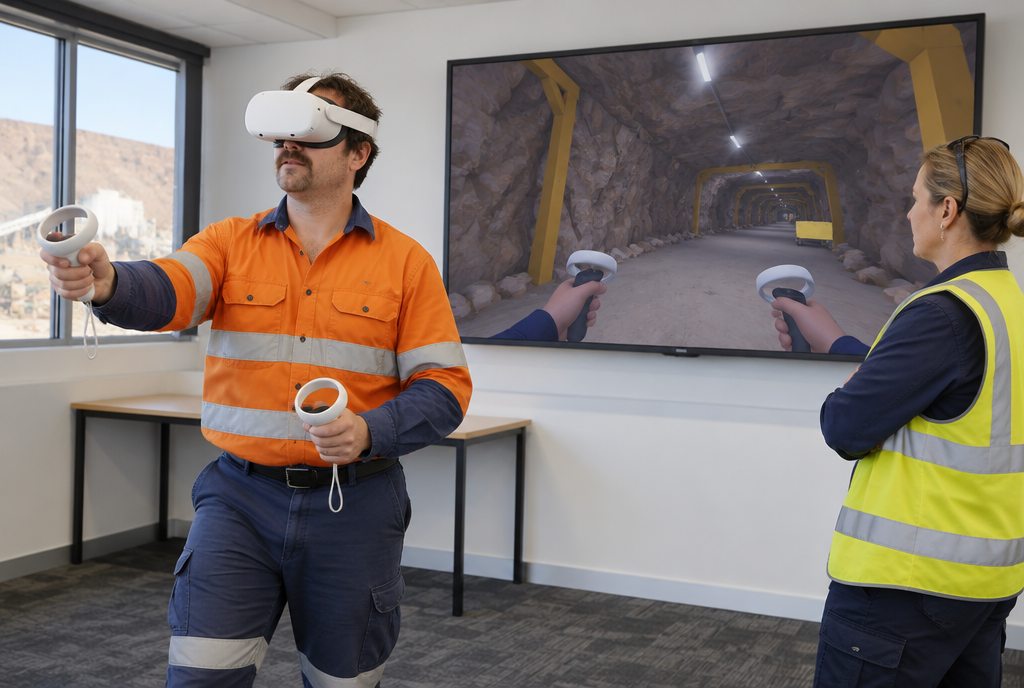
- Rare, high-consequence events. A belt fire underground, a gas release, a load swinging over people. You can't stage these for real, and a slideshow doesn't make anyone's heart rate rise.
- Spatial skills. Escape routes, blind spots, exclusion zones, where the isolation point is. VR puts the trainee in the space.
- Procedures with consequences. Trainees can skip a step, see what happens, and try again in the same session.
- Consistency. Every trainee gets the same scenario and the same scoring, which makes assessments fairer and easier to defend.
- Records. Every action is logged, so you have evidence of what was practised, not just attendance.
Where classroom training wins
- Law, regulation and theory. Duties, standards and the reasons behind procedures are taught well by a good trainer and a group discussion.
- Discussion and stories. Experienced workers sharing near-misses is one of the most powerful forms of safety training there is.
- Low cost for small groups. For one-off courses with a few people, a room and a trainer are hard to beat on price.
Where real equipment wins
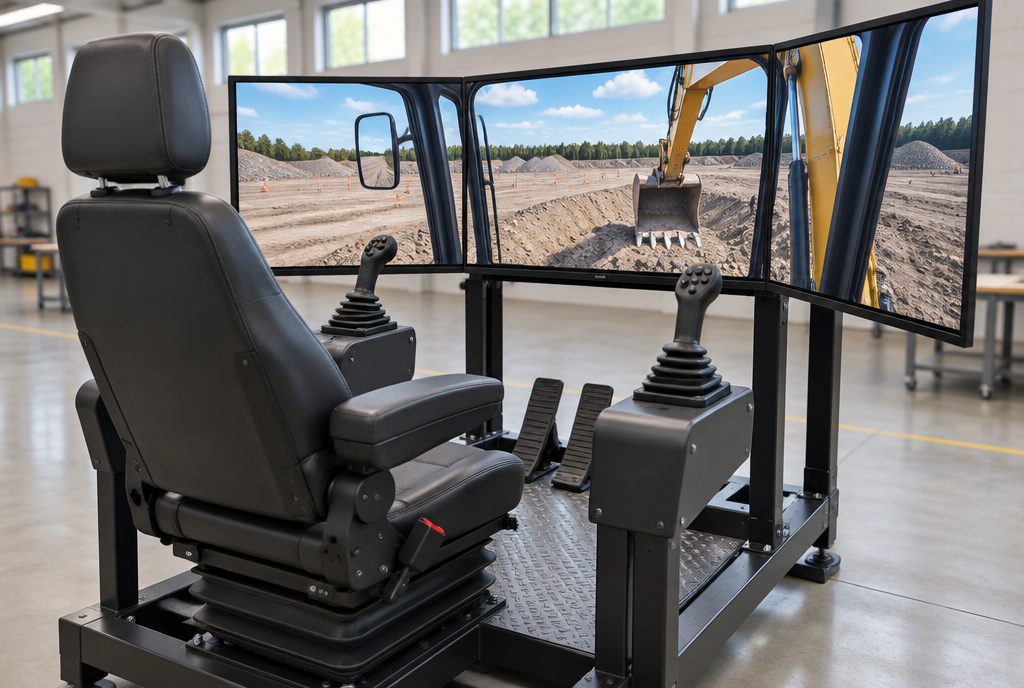
- The final feel. No simulator perfectly reproduces a real machine. Operators still need supervised time on the real thing.
- Licence assessment. High risk work licence assessments are done on real equipment by an accredited assessor. See our guide to high risk work licence classes.
Side-by-side comparison
| Classroom | VR and simulators | Real equipment | |
|---|---|---|---|
| Emergencies and failures | Described | Rehearsed safely | Rarely possible |
| Hands-on skill | None | Strong with physical controls | Strongest |
| Same test for everyone | Written test | Yes, scored automatically | Depends on conditions |
| Risk to people and plant | None | None | Real |
| Cost per extra trainee | Trainer time | Low once built | Fuel, wear, downtime, supervision |
| Evidence for audits | Attendance | Step-by-step records | Assessor notes |
A blended program that works
- Classroom for the why: duties, hazards, procedures, stories.
- VR or simulator for the how and the what-if: the procedure, the emergency, the mistake and its consequence.
- Real equipment for the final feel, under supervision, then assessment.
- VR refreshers every few months for the rare events that otherwise fade.
How to test it on your own site
Published studies won't tell you whether VR works for your crews on your tasks. A pilot will. Keep it simple:
- Pick one task with a clear, observable standard.
- Train one group the current way and one with VR or a simulator added.
- Have the same assessors assess both groups on real equipment, using the same checklist.
- Compare first-time pass rates, time to competence and assessor confidence.
That's how we start every custom training program: one crew, measured against your own assessors, before anyone commits to more.